
Academic Programs
Over the last two decades, the energy and automotive sectors have undergone rapid transformation, driven by climate change imperatives, energy security concerns, urbanization, and advances in digital and material technologies. The automotive sector accounts for a significant share of global and national energy consumption and greenhouse gas emissions, making it a critical lever for achieving net-zero and sustainable development goals. The global energy and mobility sectors are undergoing a transformative transition driven by climate change mitigation commitments, decarbonization targets, resource efficiency, and technological advancements. While renewable energy and electrified mobility, green hydrogen are expanding rapidly, conventional energy systems, particularly thermal power plants, internal combustion engine (ICE) vehicles, and fossil-based industrial systems will continue to play a significant role for several decades, especially in developing economies like India. Therefore, the Ph.D. program in Energy and Automotive Engineering recognizes that the energy transition is not a binary shift but a phased transformation requiring parallel innovation in both emerging and existing technologies. This Ph.D. program will provide a comprehensive platform to address this dual challenge. By integrating advanced research in combustion, electrification, hydrogen systems, grid integration, and smart mobility, the program will play a vital role in achieving national sustainability and energy security goals.
Objectives
- To enhance the efficiency, reliability, and environmental performance of conventional power generation systems, including coal, gas, and combined-cycle plants.
- To develop high-efficiency internal combustion engines with reduced emissions through advanced combustion strategies.
- To advance technologies in solar, wind, bioenergy, and hybrid renewable systems.
- To develop green hydrogen and its derivatives in production, storage, and their utilization in the shipping and automotive industries.
- To advance next-generation battery technologies (Li-ion, Na-ion, solid-state, beyond lithium) and energy-efficient batteries for automotive applications.
- To create globally competent researchers capable of improving the efficiency of conventional energy systems while accelerating the transition toward renewable energy, carbon-neutral fuels, intelligent mobility, and advanced energy storage technologies through data-driven and interdisciplinary approaches.
- To integrate AI techniques with the energy and automotive sectors and other futuristic applications.
Major Research Areas
- Sustainable Energy Systems
- Hydrogen ICE Technology
- Advanced Combustion and Propulsion
- Autonomous and Intelligent Mobility
- Alternative Fuels and Net-Zero Technologies
- Thermal Energy Storage
- Smart Energy Infrastructure
- Renewable Energy Integration
- Heat and Mass Transfer Analysis
- Dynamic and Multiphysics Modelling
- Computational Fluid Dynamics Modelling
- System and Design Optimization
- Life Cycle Analysis
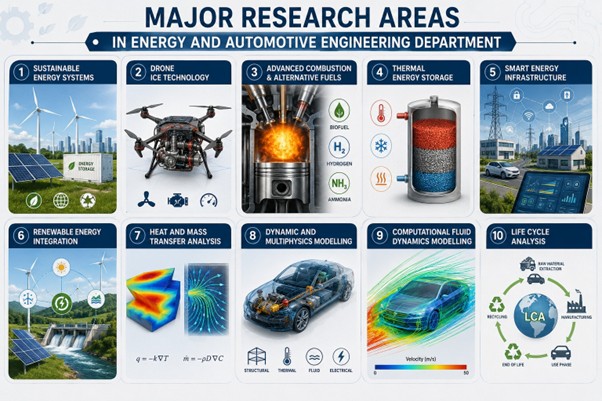
Major Research Areas
The program aims to produce globally competitive researchers capable of addressing challenges in energy sustainability, advanced mobility, and indigenous technology development.
Rolling PhD advertisement for Admission:
Click here to apply (https://erponline.iitj.ac.in/Admission/index?admiss_ch=56)
MTech Admission Link:
https://www.iitj.ac.in/admission-postgraduate-programs/en/admission-to-mtech-degree-programmes