
Postgraduate Program
Introduction
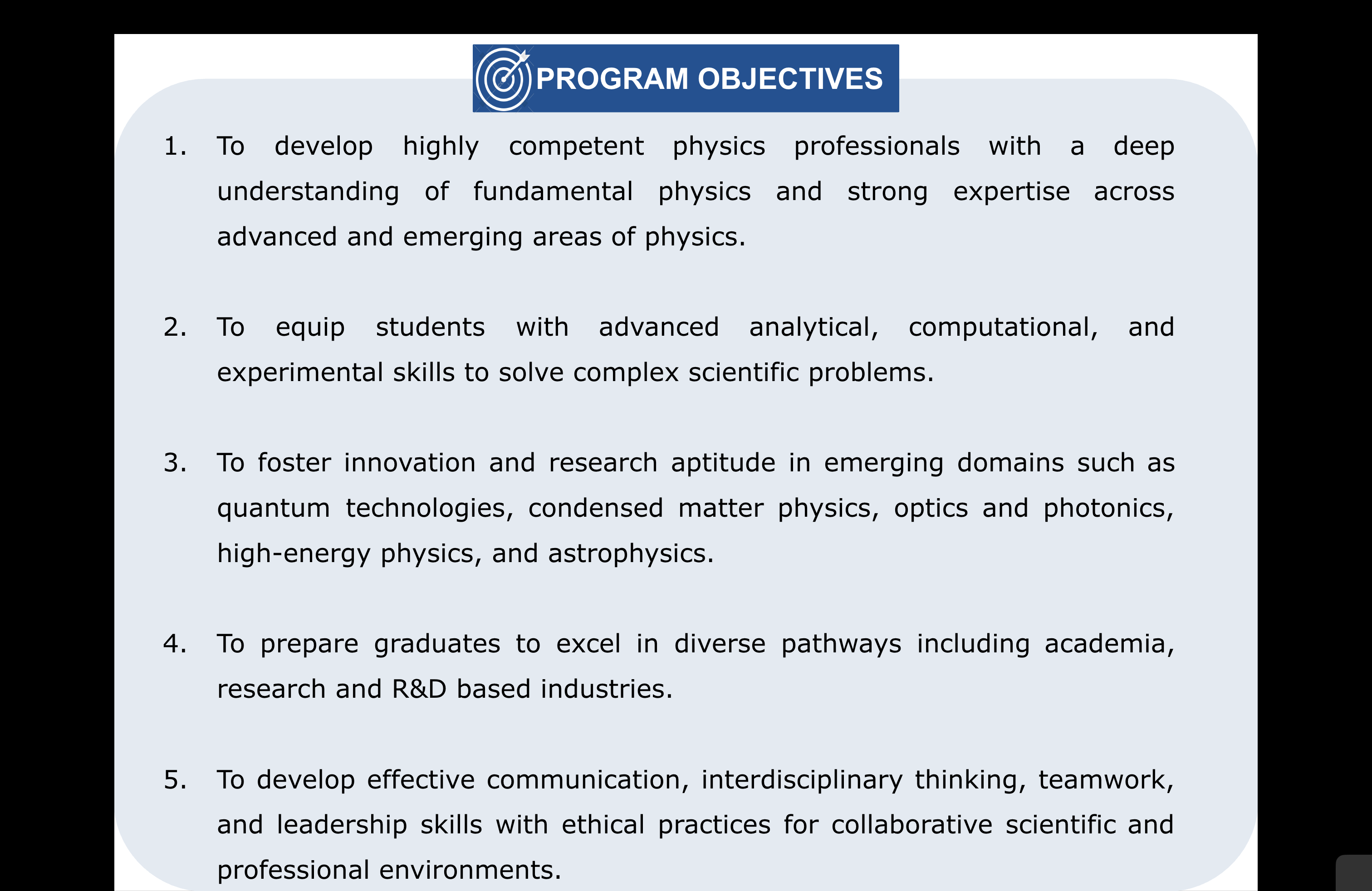
The Department of Physics at the Indian Institute of Technology Jodhpur offers an academic program, Master of Science (M.Sc.) in Physics. This program is designed on the principle that deep theoretical understanding, mathematical rigor, computational proficiency, experimental observation, and empirical inquiry together form the foundation of scientific knowledge. It bridges undergraduate foundations with applied physics towards research and innovation in emerging technologies of national and global importance.
Admissions: Through JAM Duration: 2 years Curriculum of MSc Program
NOTE: Before 2026, the Department of Physics at IIT Jodhpur offered the following two postgraduate programs. The curricula of these programs are outlined below
- M.Sc. (Physics) – 2 years
- MSc (Physics)-M.Tech. (Materials Engineering) Dual Degree Program - 4 years
Key Highlights
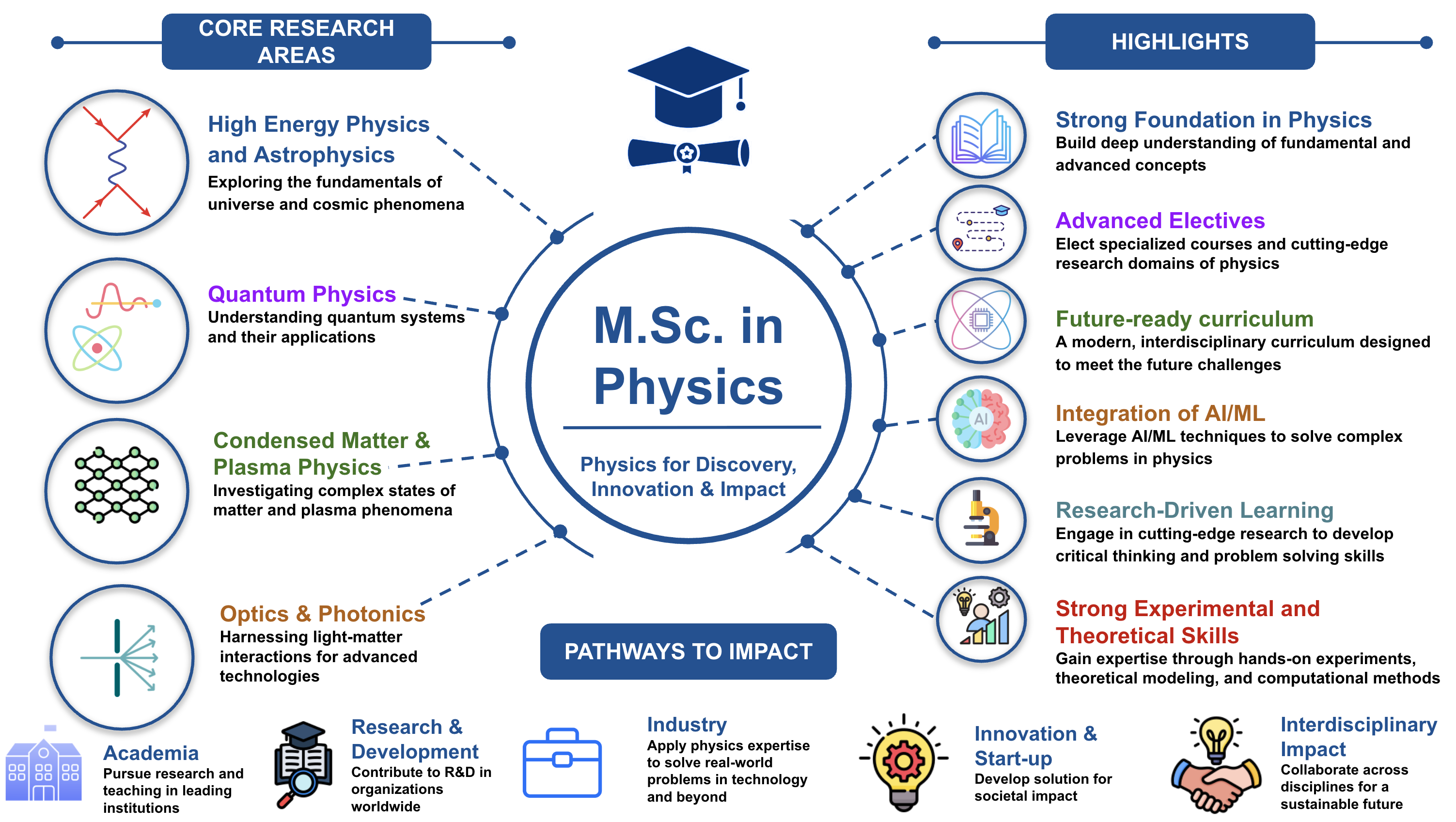
- Strong Foundation in Physics: A rigorous first-year curriculum covering all core areas of physics, providing a comprehensive foundation in classical, quantum, statistical, condensed matter, and electromagnetic physics.
- Advanced Electives: Domain-specific elective courses in the second year allow students to specialize in frontier areas aligned with their research interests and career aspirations.
- Future-Ready Curriculum: A modern curriculum designed around emerging scientific and technological frontiers, including Quantum Technologies, Advanced Materials, Photonics, Energy Science, and Computational Physics.
- Integration of AI & Machine Learning: Dedicated emphasis on Machine Learning, Scientific Computing, and Data-Driven Physics to equip students with computational skills increasingly demanded in research and industry.
- Research-Driven Learning: Extensive laboratory training, computational projects, and a year-long research dissertation under the guidance of IIT Jodhpur faculty, fostering innovation and independent scientific inquiry.
- Interdisciplinary Ecosystem: Opportunities to collaborate across Physics, Materials Engineering, Electrical Engineering, Computer Science, AI, and interdisciplinary research centres, promoting cross-disciplinary problem solving.
- Hands-on Experimental & Computational Training: Exposure to state-of-the-art experimental facilities, advanced characterization techniques, numerical modelling, and high-performance computing.
- Preparation for Diverse Careers: Graduates are well prepared for Ph.D. programmes at leading national and international institutions, R&D positions in academia, national laboratories, semiconductors, quantum technologies, energy, defence, data science, AI-enabled industries, and high-technology startups.
- Innovation & Entrepreneurship: Exposure to translational research, technology development, and entrepreneurship through IIT Jodhpur's vibrant innovation ecosystem.
| S. No. | Program Core Courses | Program Elective Courses |
|---|---|---|
| 1 | Mathematical Physics | Advanced Condensed Matter Physics |
| 2 | Classical Mechanics | Advanced Statistical Physics |
| 3 | Quantum Mechanics | Cold Plasma Technologies |
| 4 | Electronics | Energy Harvesting |
| 5 | Statistical Physics |
Introduction to Material Characterization |
| 6 | Electrodynamics | Quantum Materials and Devices |
| 7 | Condensed Matter Physics | General Theory of Relativity |
| 8 | Atomic and Molecular Spectroscopy | High Energy Physics |
| 9 | Nuclear and Particle Physics | Particle Accelerators and Detectors |
| 10 | Advanced Quantum Mechanics | Quantum Field Theory |
| 11 | Scientific Computing and Machine Learning |
Laser Technologies and Ultrafast Optics |
| 12 | Physics Lab 1 | Nonlinear Optics |
| 13 | Physics Lab 2 | Fiber-Optic Communication |
| 14 | Device-independent Quantum Technologies |
|
| 15 | Open Quantum Systems | |
| 16 | Quantum Optics and Engineering |
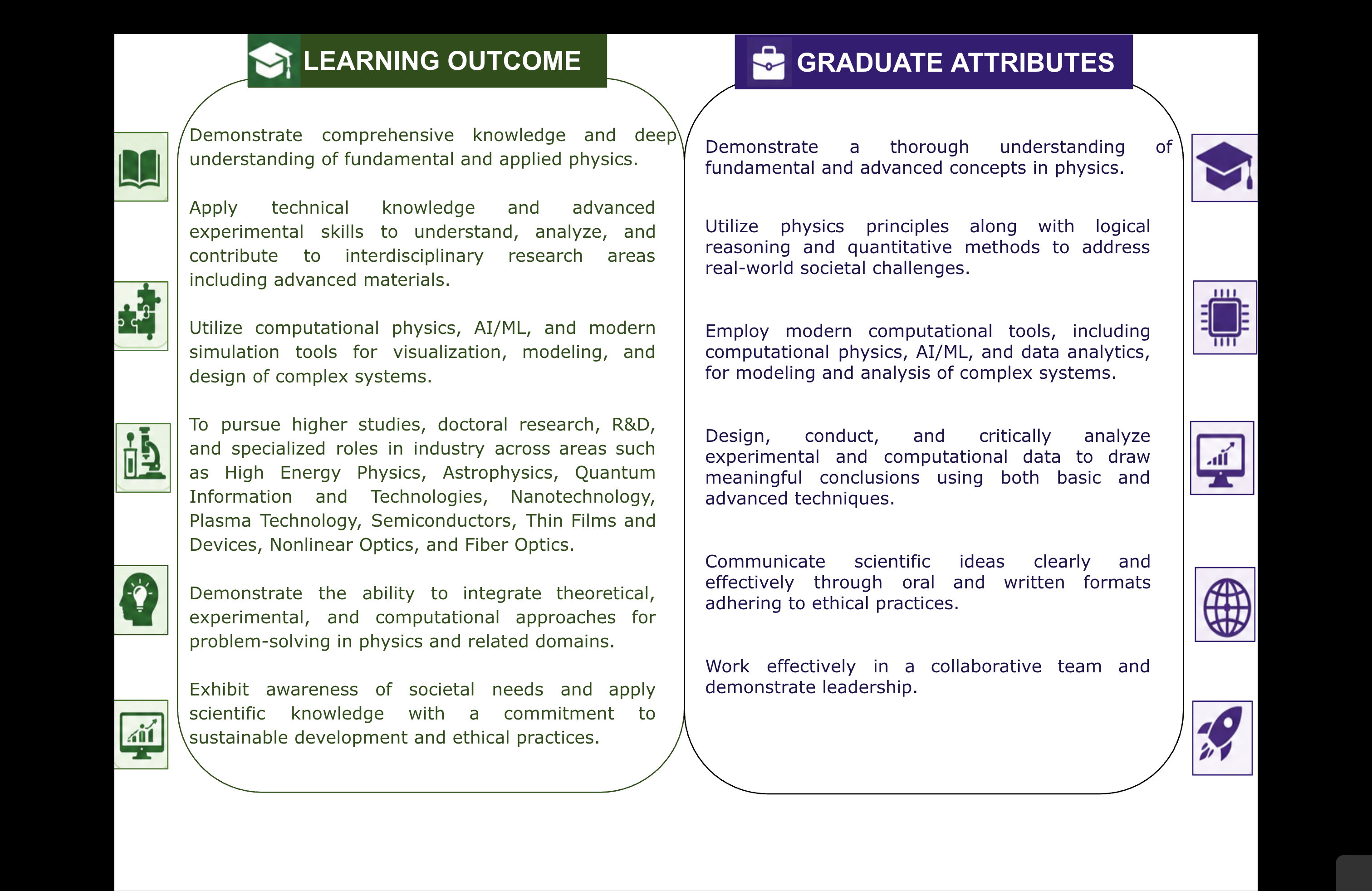
Outcome and Opportunities:
FAQ
Q1. Can students pursue a Minor from another department while enrolled in the M.Sc. program?
Ans: No.
Q2. Will students receive research exposure during the program?
Ans: Yes. The program provides extensive research opportunities through laboratory courses, project work, dissertation, and participation in ongoing research activities under faculty supervision. Students are encouraged to engage in research from the early stages of the program.
Q3. Is the M.Sc. in Physics program offered as an integrated M.Tech. dual-degree program?
Ans: No. The M.Sc.- M.Tech. Dual Degree in Physics and Materials Engineering program has been discontinued. The current M.Sc. in Physics program is a standalone program and is not associated with an integrated M.Tech. degree.
Q4. Can graduates pursue a Ph.D. after completing the M.Sc. in Physics program?
Ans: Yes. Graduates are eligible to apply for Ph.D. programs in India and abroad, subject to the admission requirements of the respective institutions. The strong research training provided during the program prepares students for doctoral studies.
Q6. Is it possible to choose a specialization in other domains?
Ans: No. The current M.Sc. in Physics program is a standalone program without any specialization. However, the program offers the flexibility to take elective courses from the department, in which a student can curate the courses to gain specialization in one of the domains (High energy, Condensed Matter, Optics & Photonics or Quantum Physics and Computation).
Q8. Are internship opportunities available during the program?
Ans: Yes. An internship is a mandatory component of the program. Students are required to undertake internships in industries, research laboratories, startups, or academic institutions. Faculty members actively guide and support students in identifying suitable internship opportunities aligned with their academic interests and career goals.
Q9. Whom should I contact for additional questions and queries?
Ans: For any additional questions or clarifications regarding the M.Sc. in Physics program, please contact us at office_physics@iitj.ac.in